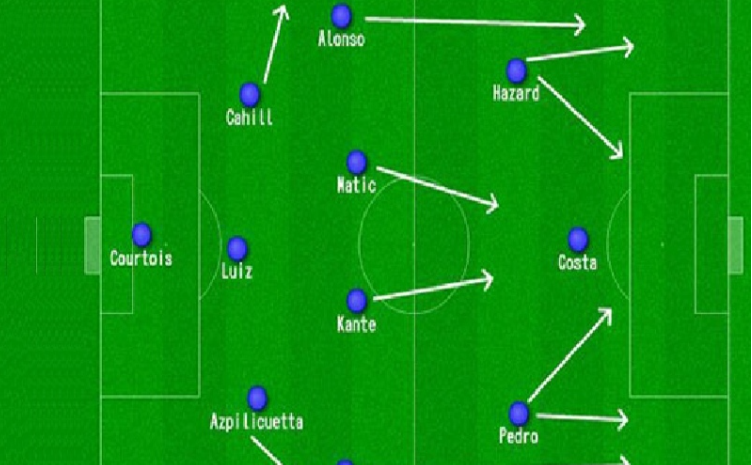
When exploring the strongest attacking formations, fans are often interested in systems that can maintain constant pressure while preserving the team’s overall structure. In reality, there is no single formula that suits every team, as effectiveness also depends on player quality, coaching philosophy, and the characteristics of the opposition. Below are three prominent formations often praised for their ability to support proactive play.
Top 3 strongest attacking formations worth noting
According to Xôi Lạc Link, an effective attacking system needs to provide width, depth, and connectivity between the different lines.
4-3-3 – creating pressure through three attacking outlets
According to Xôi Lạc Link, the 4-3-3 is one of the most familiar systems in modern football. Its basic structure consists of four defenders, three midfielders, and three attackers. The two wingers can stay wide to stretch the defense or move inside to create numerical superiority between the opposition’s lines.
The greatest strength of the 4-3-3 lies in its natural width. When the two wingers stay close to the touchlines, opposing defenders are forced to spread out. This creates opportunities for the central striker and the two number 8 midfielders to exploit spaces just outside the penalty area.
In pressing situations, the three forwards also apply direct pressure on the opposition’s defense. If the central striker blocks the passing lane to a center-back while the two wingers press from either side, the opposition may be forced to play long balls or attempt risky passes.
A high-quality defensive midfielder helps make the 4-3-3 more balanced. This player supports ball circulation while protecting the central areas when the full-backs push forward. This is why the system is often chosen by teams seeking to dominate possession, press aggressively, and maintain control of the game.

4-2-3-1 – balancing creativity and control
Fans who regularly check tỷ lệ kèo bóng đá hôm nay and analyze tactics on Xoilac TV will also recognize the 4-2-3-1 as a highly flexible system. The two central midfielders form an important protective layer in front of the defense, while a number 10 operates just behind the lone striker.
The number 10 is the tactical focal point. This player can drop deep to receive the ball, move into either half-space, or enter the penalty area when the striker draws a center-back out of position. With strong passing skills and the ability to operate in tight spaces, the number 10 can become the team’s primary creative force.
The two wide attackers also have several movement options. They can stay wide to stretch the pitch or move inside to create space for overlapping full-backs. This allows the team to adjust its attacking approach according to how the opposition defends.
According to tactical analysis, the 4-2-3-1 provides a considerable balance between defensive protection and attacking creativity. However, the system depends heavily on the quality of the number 10 and the coordination between the two central midfielders.
Viewers watching a team use the 4-2-3-1 on XoilacTivi can pay attention to the distance between the number 10 and the striker. If these two positions combine effectively, the opposing defense will often face several difficult decisions.
3-4-3 – maximizing the use of both flanks
Xôi Lạc TV notes that the 3-4-3 uses three center-backs, four midfielders, and three attackers. In attacking situations, the wing-backs can push very high, effectively becoming wide forwards. The three players up front can then focus more on exploiting central areas and the spaces between defenders.
The 3-4-3 is particularly effective against teams that defend narrowly. Stretching the opposition’s defensive line toward both flanks can open up space for forwards or midfielders making runs into the box. In addition, the three center-backs provide a solid foundation for building attacks from the back.
However, this system requires wing-backs with excellent stamina, speed, and positional awareness. If both players push forward and the team loses possession too easily, the spaces behind them can become weaknesses for the opposition to exploit.
Comparing the three systems in terms of attacking strength
When comparing the three options, the 4-3-3 stands out for its three direct attacking outlets, pressing ability, and width. The 4-2-3-1 emphasizes balance and suits teams with a creative player operating between the lines. Meanwhile, the 3-4-3 offers the ability to create numerical superiority on both flanks and apply intense pressure in the final third.
When watching live football on Xôi Lạc Link, viewers can recognize the differences by observing how each team moves players forward. In the 4-3-3, the wings are often the starting point for attacks. In the 4-2-3-1, the area behind the striker plays a crucial role. The 3-4-3, meanwhile, frequently relies on the speed and forward runs of its wing-backs.
From the perspective of applying sustained pressure, the strongest attacking formation needs to maintain multiple attacking layers rather than relying on a single individual. When players can interchange positions continuously, opponents find it harder to identify whom they need to mark.
Player roles determine tactical effectiveness
XoilacTivi observes that a good system can only reach its full potential when the players are suited to its tactical demands. The 4-3-3 requires wingers with speed, technical ability, and pressing skills. The two number 8 midfielders must be mobile enough to contribute to both attacking and defensive phases.
In the 4-2-3-1, the number 10 is a particularly important link. If this player is tightly marked, the team may lose its main connection between midfield and attack. Conversely, a number 10 who can receive the ball between the lines will force the opposition’s defense to constantly adjust its positioning.
In the 3-4-3, the wing-back position cannot be overlooked. These players must be able to perform at high intensity throughout the match. The three center-backs also need speed and passing ability to support the build-up from the defensive third.
These factors show that the strongest attacking formation cannot be separated from player quality. A team with suitable players can turn an ordinary system into an extremely dangerous attacking structure. Fans checking tỷ lệ kèo bóng đá hôm nay and watching matches through XoilacTivi can observe these changes by tracking the positioning of full-backs, defensive midfielders, and wingers.
Conclusion
The strongest attacking formation should not be understood as a fixed formula. An effective system must be selected according to the available players, the opposition, the match objectives, and the team’s ability to transition between phases of play. When watching matches through Xôi Lạc Link, fans can observe tactical adjustments and changes in tỷ lệ kèo bóng đá hôm nay to understand why one team creates more chances than its opponent.